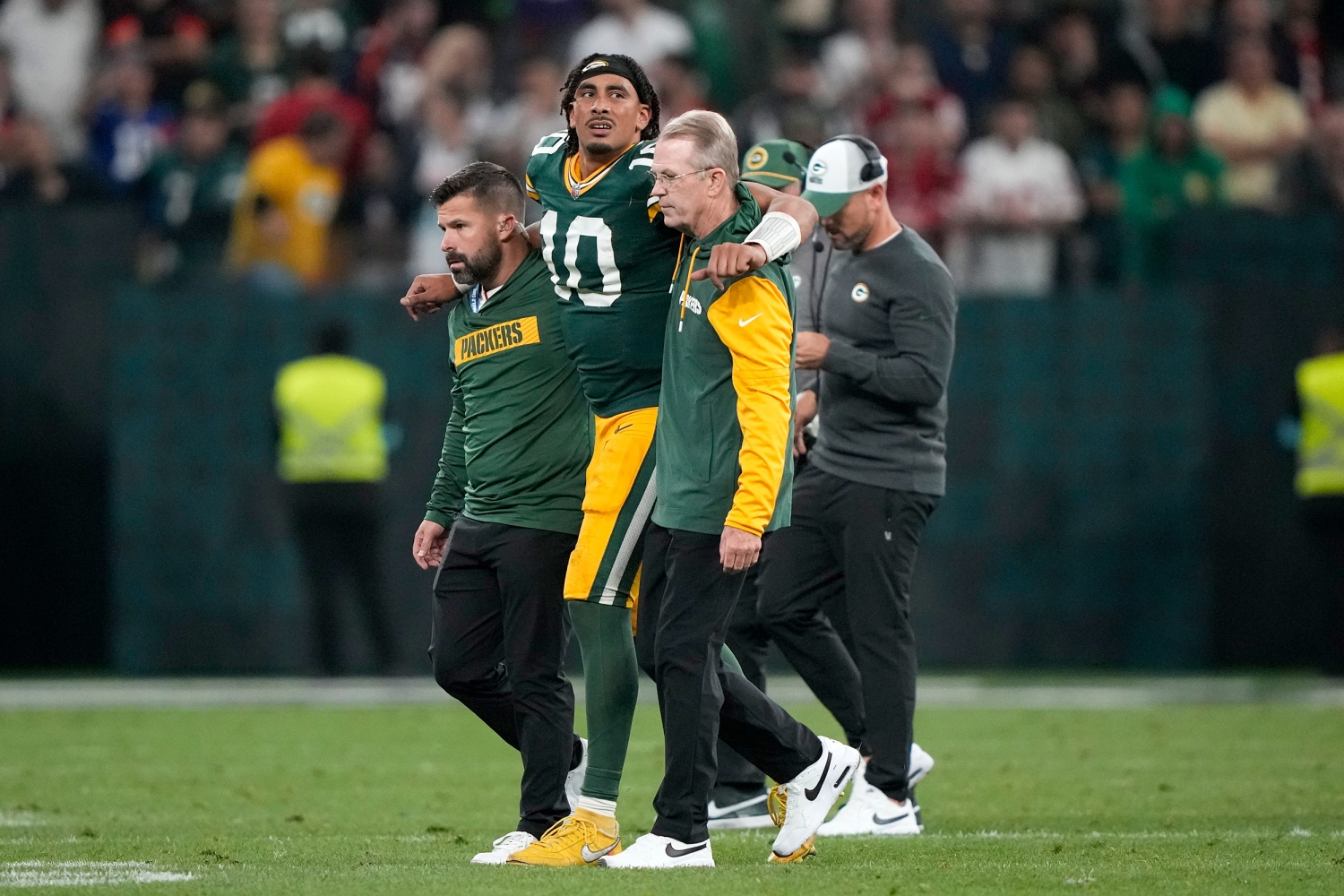
Jordan Love Injury Update: Short-Term Setback, Playing Through Pain, and the Bigger Picture for a Franchise Quarterback
Jordan Love’s injury situation has become a focal point for discussions around durability, decision-making, and long-term planning at the quarterback position. As a player transitioning from promise to responsibility, any physical concern carries weight far beyond a single game. For quarterbacks, whose value lies in consistency and availability, even minor injuries can influence performance, confidence, and team direction.
Love’s injury emerged during competitive play, where physical contact and repeated pressure are unavoidable realities of the position. While the issue has not been described as severe or season-ending, it has raised questions about how much discomfort a quarterback can reasonably manage while still performing at an effective level.
You might also like
Bayern Munich Secure New Stadium in Major Investment for Women’s Team
04:03 agoQuarterback injuries are unique in that they often involve functional limitations rather than outright absence. Unlike positions that rely primarily on sprinting or contact, quarterbacks must maintain throwing mechanics, balance, and pocket movement. Any injury affecting the lower body or core can subtly alter footwork, timing, and accuracy, even if the player remains active.
In Love’s case, the concern is less about a dramatic physical breakdown and more about accumulated stress. Playing through pain is often celebrated in professional football, but it carries risks. Compensating for discomfort can place strain on other areas of the body, increasing the likelihood of secondary injuries and inconsistent performance.
The mental challenge of managing a nagging injury is significant for a quarterback. Decision-making under pressure demands clarity and confidence. When physical discomfort enters the equation, hesitation can appear in pocket movement or throwing rhythm, affecting reads and execution. For a developing quarterback, these moments can shape perception as much as results.
Related Article

Who Are the Favorites to Win the World Cup 2026?
04:08 agoFrom a team perspective, balancing competitiveness with caution becomes critical. Sitting a quarterback protects long-term health but may disrupt offensive continuity. Playing through discomfort preserves rhythm but risks escalation. Coaching staffs must assess not only medical clearance but also functional effectiveness when making these decisions.
Love’s role as a franchise quarterback amplifies the importance of careful management. Teams invest heavily in developing quarterbacks, and long-term availability often outweighs short-term gain. Protecting mechanics, confidence, and durability is essential, particularly during formative seasons when habits are established.
Another factor is game planning. Injuries can influence play-calling, with teams adjusting protection schemes, rollout frequency, and throwing depth to reduce strain. While these adaptations can help in the short term, they may also limit offensive variety if extended over time.
The modern NFL increasingly recognises the value of strategic rest and controlled recovery. Short absences or reduced workloads are no longer seen as signs of weakness, but as tools for preserving performance across a long season. For quarterbacks, this approach often extends careers and improves late-season effectiveness.
For fans, understanding the context of quarterback injuries is important. Statistics alone rarely tell the full story. Accuracy dips, reduced mobility, or conservative decision-making may reflect physical limitations rather than regression. Evaluating performance without considering health can lead to misleading conclusions.
Looking ahead, Love’s recovery and management will shape expectations. A cautious approach may temporarily slow momentum, but it can also prevent long-term issues that derail development. The goal is not simply to play, but to play well and sustainably.
Ultimately, Jordan Love’s injury update represents a common but critical challenge in professional football. Quarterbacks walk a fine line between toughness and preservation, and how that balance is handled often defines careers. With proper management, this setback does not signal concern — it marks an opportunity to prioritise longevity over urgency.
In the NFL, success is measured not only by talent, but by how well that talent is protected.


No comments yet. Be the first to share your thoughts!