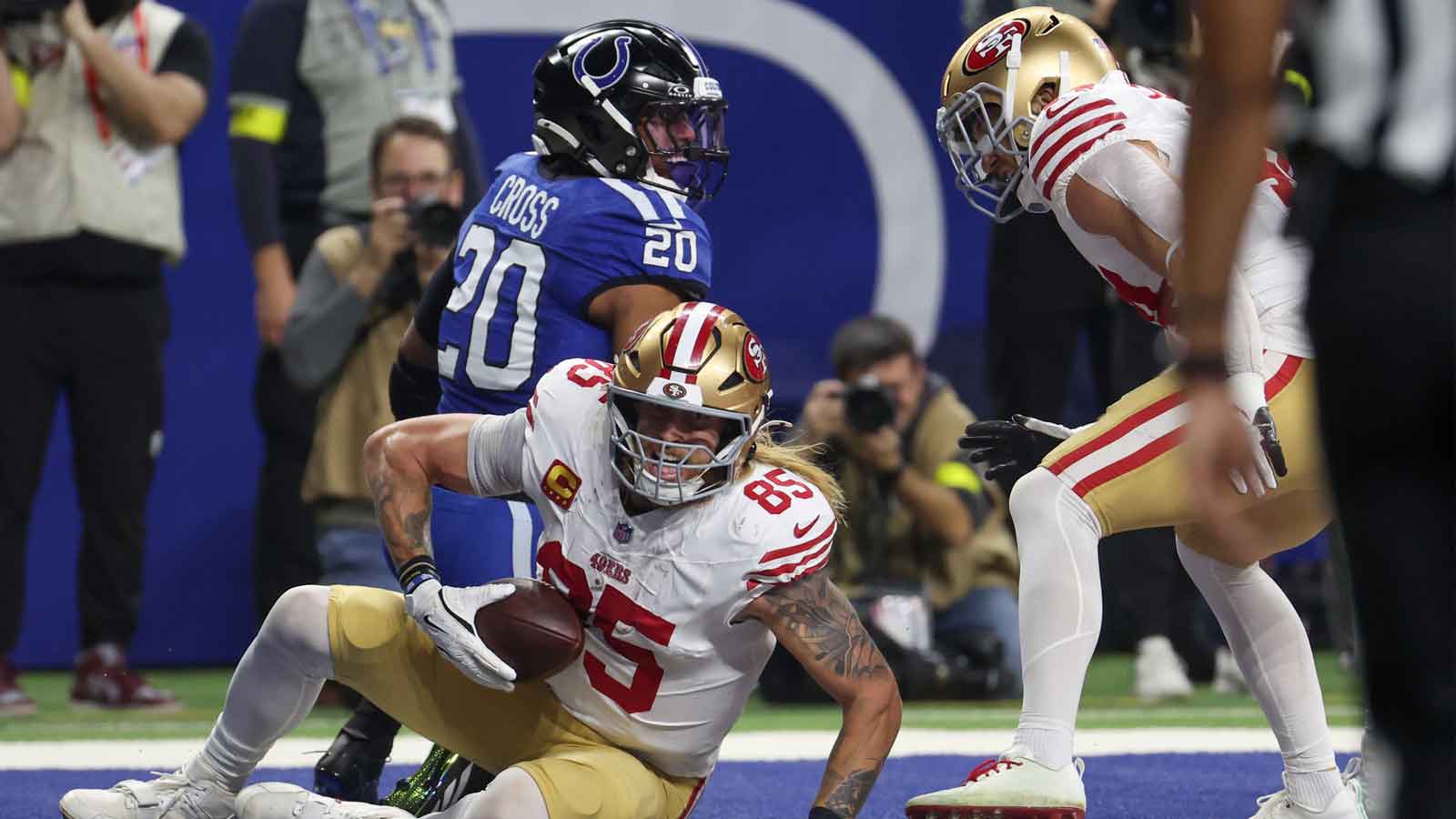
George Kittle Injury Update: Ankle Concern, Durability Questions, and What It Means for His Season
George Kittle’s latest injury has once again drawn attention to the physical toll endured by one of the most dynamic and demanding positions in American football. The San Francisco 49ers tight end, widely regarded as one of the most complete players in the NFL, is currently dealing with an ankle injury that forced him out of a game and placed his immediate availability in doubt.
For a player whose impact goes far beyond statistics, any injury raises significant questions. Kittle is not only a primary receiving threat but also a crucial blocker, emotional leader, and tone-setter for the offense. When he is limited, the ripple effect is felt across the entire team structure.
You might also like

Match Full-time Insight: Real Madrid 6-1 Monaco
22:40 agoAnkle injuries are particularly challenging in the NFL due to the constant cutting, planting, and contact involved on every snap. For tight ends, the challenge is even greater. They are required to explode off the line, absorb hits from defenders, and maintain balance while blocking much larger opponents. Even minor ankle instability can reduce effectiveness and increase vulnerability to further injury.
In Kittle’s case, the injury occurred during live play and was severe enough to prevent him from continuing. While initial reports suggest it may not be season-ending, the uncertainty surrounding ankle injuries often lies in how well the joint responds to treatment under game conditions rather than in training environments.
The recovery process for an ankle issue depends heavily on pain tolerance, swelling management, and joint stability. Players can sometimes return quickly if mobility is preserved, but doing so without full stability increases the risk of aggravation. For someone like Kittle, whose role involves repeated physical collisions, caution becomes essential.
Related Article

Avoid This Match Today: Qarabağ FK vs Eintracht Frankfurt
22:42 agoDurability has long been a talking point in discussions about Kittle. While his competitive intensity and fearless style are key reasons for his success, they also expose him to frequent contact and cumulative wear. Over the years, he has played through multiple injuries, earning respect for toughness but also raising concerns about long-term sustainability.
From a tactical standpoint, Kittle’s absence or limitation forces significant adjustments. Offensive schemes that rely on tight ends for both protection and receiving flexibility become more predictable without him. His ability to disguise plays — lining up as a blocker before releasing into routes — is difficult to replicate with backups.
Quarterbacks often rely on tight ends as safety valves, particularly in high-pressure situations. Kittle’s chemistry, physical catch radius, and ability to gain yards after contact make him invaluable on third downs and in the red zone. Losing that presence alters decision-making and play-calling.
The mental aspect of playing through ankle injuries is also significant. Confidence in planting and pushing off affects timing, separation, and blocking leverage. Any hesitation can be exploited immediately at NFL speed. For Kittle, whose game thrives on aggression and commitment, even slight uncertainty can impact performance.
Medical staff typically monitor ankle injuries closely through imaging, strength testing, and response to load. Decisions about return often come down to balancing competitive urgency with long-term health. In playoff-contending teams, this balance becomes even more delicate.
One advantage working in Kittle’s favour is experience. Veteran players often manage injuries more effectively, understanding when to push and when to step back. Kittle’s football intelligence and professionalism allow him to adapt his game when necessary, focusing on positioning and technique rather than pure explosiveness.
However, repeated lower-body injuries can accumulate, particularly for players who never shy away from contact. Managing snap counts, limiting unnecessary exposure, and designing plays that reduce impact can help preserve effectiveness over the course of a season.
For fans, Kittle’s injury update serves as a reminder of how physically demanding the NFL truly is. Unlike short-term absences that resolve quickly, joint injuries linger, often fluctuating week to week. Availability becomes a moving target rather than a fixed timeline.
Ultimately, George Kittle’s situation highlights the fine line between toughness and preservation. His value to the team is unquestioned, but protecting that value requires restraint as much as courage. How his ankle responds over the coming weeks will determine not only his individual contributions but also the offensive ceiling of the team.
If managed carefully, this injury does not have to derail his season. But in a league defined by attrition, durability often proves just as important as dominance.









No comments yet. Be the first to share your thoughts!