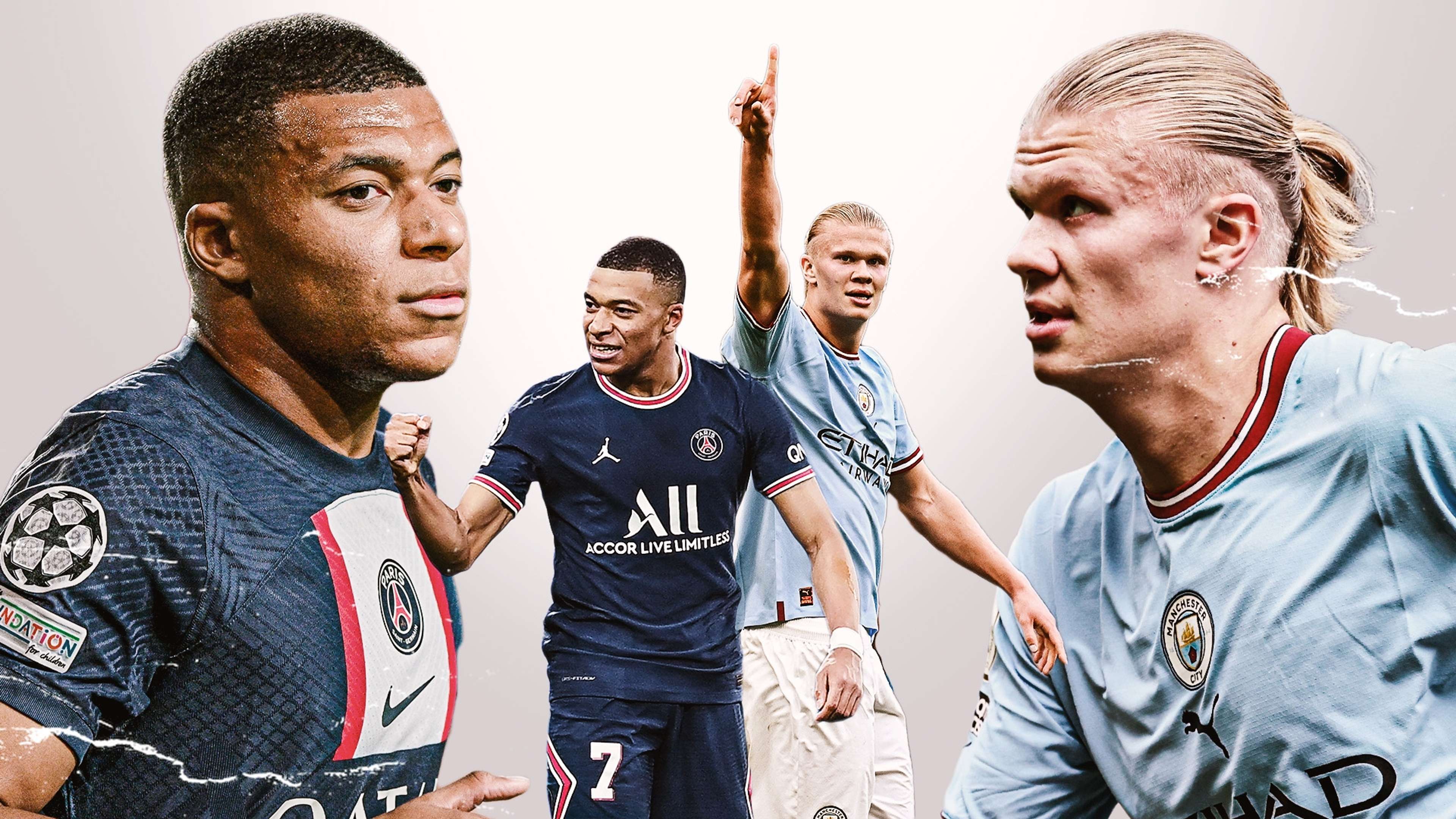
The rivalry between Kylian Mbappé and Erling Haaland represents the future of elite football. Unlike debates rooted in history, this comparison is unfolding in real time. Both players are redefining goal scoring for a new generation, and the question is no longer whether they will dominate world football, but how differently they will do it.
Mbappé and Haaland are often mentioned in the same breath because they represent the natural successors to an era defined by Messi and Ronaldo. Yet stylistically, mentally, and tactically, they could not be more different.
You might also like
World Cup 2026 Match Schedule Explained
03:56 agoKylian Mbappé’s game is built on speed, intelligence, and versatility. Few players in football history combine explosive acceleration with such composure in front of goal. Mbappé thrives in open space, where his pace stretches defensive lines and forces opponents into reactive positioning. His movement is instinctive, often arriving where defenders least expect him.
Beyond speed, Mbappé’s greatest strength is adaptability. He is equally comfortable operating from wide areas, drifting inside, or leading the line. This flexibility allows teams to build fluid attacking systems around him rather than rigid structures. Mbappé does not simply finish chances — he creates chaos that leads to chances.
Erling Haaland, on the other hand, represents physical inevitability. His presence alone alters how teams defend. Tall, powerful, and relentlessly direct, Haaland thrives inside the penalty area, where his movement, strength, and finishing efficiency make him almost impossible to contain. Defenders are forced to defend deeper, compressing space and reshaping entire defensive blocks.
Related Article

The Kelly Criterion: Mathematical Approach to pick Sizing
02:35 agoHaaland’s scoring efficiency is remarkable not because of volume alone, but because of clarity. He rarely overcomplicates actions. His game is based on timing runs, attacking space, and converting chances with minimal touches. Where others need multiple opportunities, Haaland often needs one.
Tactically, Mbappé influences games across larger areas of the pitch. He contributes to build-up play, transitions, and counter-attacks, often dictating tempo through movement rather than possession. His presence allows teams to play vertically, punishing high defensive lines and slow transitions.
Haaland’s influence is more concentrated but equally powerful. He anchors attacking structures, allowing teammates to focus on chance creation rather than goal scoring responsibility. His positioning creates space around him, even when he does not touch the ball, because defenders are constantly drawn toward him.
Mentally, both players exhibit elite confidence, but in different ways. Mbappé plays with flair and expression, often embracing pressure moments as opportunities to define games. He appears comfortable as the face of teams and tournaments, carrying expectation with visible belief.
Haaland’s mentality is colder and more mechanical. He approaches goal scoring as a task to be executed repeatedly, showing little emotional fluctuation regardless of context. This mindset allows him to maintain consistency even in high-pressure environments.
Another key difference lies in international football. Mbappé has already delivered defining performances on the biggest stages, shaping tournament outcomes and embracing leadership roles early in his career. His influence extends beyond numbers, impacting how matches unfold tactically.
Haaland’s international environment presents a different challenge. Carrying a national team with fewer resources places greater emphasis on individual efficiency rather than collective dominance. In this context, his ability to convert limited chances becomes even more valuable, even if overall team success is harder to achieve.
Longevity and evolution will define how this rivalry is remembered. Mbappé’s game may gradually shift toward playmaking and positional intelligence as raw speed declines. Haaland’s evolution may involve deeper involvement in build-up play as defenders adapt to his presence.
The question of who is better ultimately depends on team needs. Teams seeking fluidity, transition dominance, and positional flexibility gravitate toward Mbappé. Teams prioritising penalty-box dominance, aerial threat, and ruthless efficiency lean toward Haaland.
Importantly, football does not need to choose between them. Like past rivalries, their coexistence elevates standards. Defenders must adapt, coaches must innovate, and fans witness contrasting expressions of excellence.
Mbappé vs Haaland is not just a comparison — it is a preview of football’s next dominant era. One represents speed and space, the other power and precision. Together, they define the future of goal scoring.
History may eventually decide who had the greater career, but the present already confirms one thing: football’s next great rivalry has arrived.



No comments yet. Be the first to share your thoughts!